Category Archives: Tunepal

Tunepal being rebuilt in GODOT

Tunepal has served traditional musicians faithfully since 2009 and is beloved by a generation of traditional musicians. WIth around 100K lifetime users who have performed millions of searches, each search represents a tune identified and maybe a new tune learned by a musician somewhere.

In recent years it has become harder are harder to maintain Tunepal due to increasing load on the old technology stack that makes Tunepal work.

With that in mind, I am proud to announce that I am now officially working a totally new version of Tunepal!

The new Tunepal will be 100% free, and built with the Open Source Godot Game Engine. It will work offline, with no dependancy on a back-end server and in time will support many new features, better tune recognition and the ability to load in tune collections, share tunes, organise tunes into sets. The source code will be freely available for anyone to take, modify and improve on. There is a prototype developed and I will share more details and a github repo to which anyone can contribute, in the coming days. I am excited fot the next chapter in Tunepal and look forward to welcoming collaborators to help bring this project forward! If you are a coder and you know Godot or C++ and have time to give this important project, then star the repo or fork it and start working!

Update: The build in the repo now has many of the essential elements. Transcription, matching, tune database. It compiles and runs on Windows and Android. Still a lot of work to do so please consider helping
Ten Years of Tunepal: Reflections and Future Directions

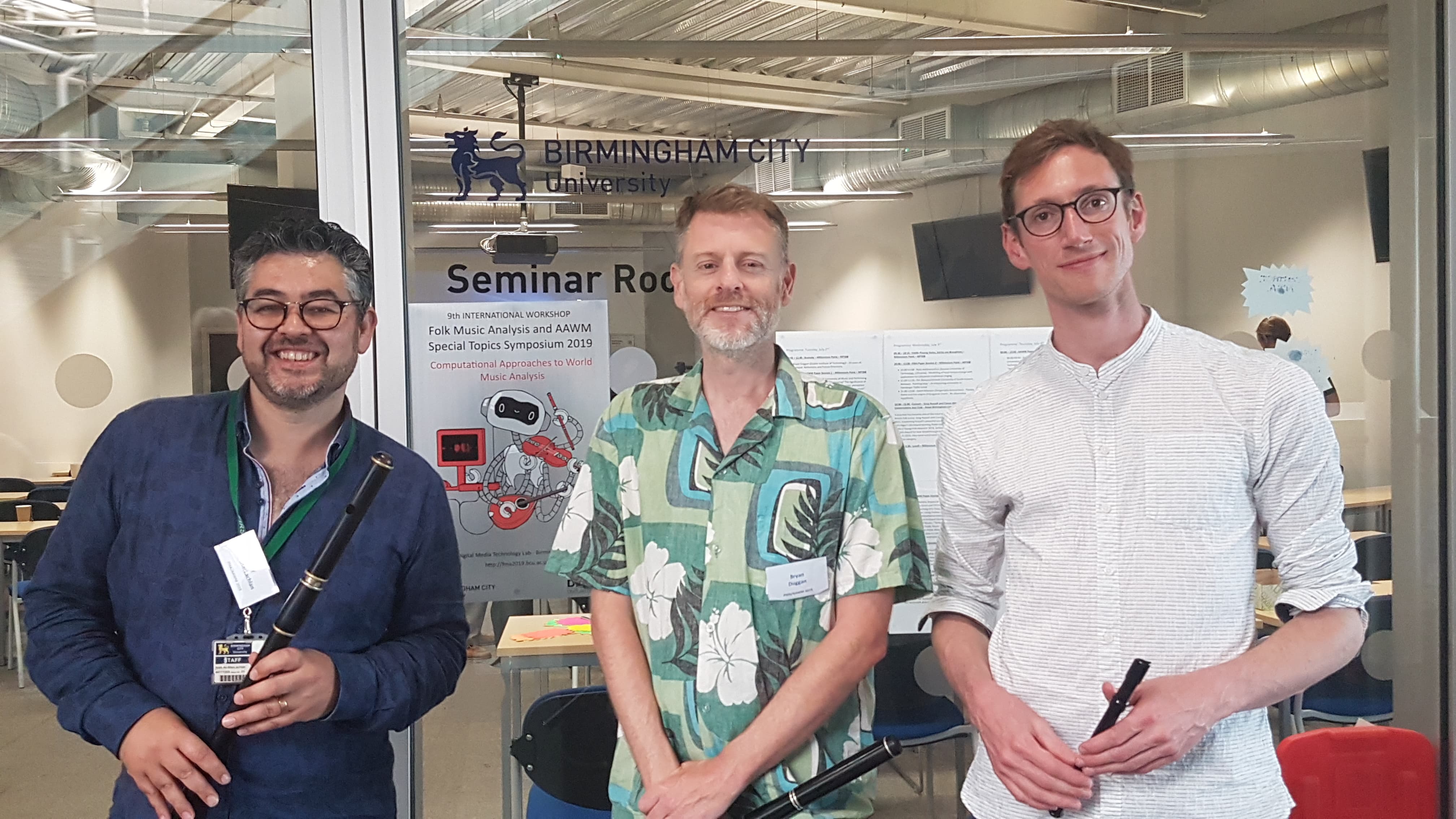
I gave the keynote presentation at the 9th International Workshop on Folk Music Analysis on 2 July 2019 in Birmingham City University. Here is a photo of Izzy McLaughlan (conference chair), myself and Pierre Beauguitte, PhD student from TU Dublin.

65966290_389486658357893_6432244534041640960_n (1)

My talk was a retrospective on the last ten years of Tunepal, and possible directions for future development of the project. I described how the project has grown in popularity and now serves around 60K searches per month. I also talked about various collaborations including the Tunetracker project developed by Norman Su and myself and the collaboration with Europeana Sounds that led to the ability to retrieve audio recordings from the Comhaltas archive through tunepal.org. I discussed Pierre Beauguitte’s excellent work in addressing many of the limitations of the existing Tunepal, such as improving transcription accuracy, automatically inferring the key and time signature of an audio recording and key invariant tune identification.

My slides from the talk:

A beautiful visualisation of 10 years of Tunepal searches made by Katie Kilroy:

https://public.tableau.com/profile/katie.kilroy#!/vizhome/TunePal-30JUNE2019/BRYANVERSION

And a visualisation I made of 5000 geotagged queries:

https://public.tableau.com/profile/bryan.duggan#!/vizhome/5000GeotaggedQueries/Tunepalmusicsearches?publish=yes

Pierre’s work:

Beauguitte, P., Duggan, B., Kelleher, J. (2016). A Corpus of Annotated Irish Traditional Dance Music Recordings: Design and Benchmark Evaluations. 17th International Society for Music Information Retrieval Conference 2016, , New York City, August 7-11.
Download the paper: http://arrow.dit.ie/scschcomcon/177
And the dataset: http://arrow.dit.ie/datas/1

Beauguitte, P., Duggan, B. and Kelleher, J. (2017) Key inference from Irish traditional music scores and recordings. 14th Sound and Music Computing Conference, July 5-8, 2017, Espoo, Finland.
Download the paper: http://arrow.dit.ie/scschcomcon/209

Beauguitte, P., Duggan, B. & Kelleher, J. D. (2018). Rhythm inference from audio recordings of Irish traditional music. Proceedings of the 8th International Workshop on Folk Music Analysis, 26-29 June 2018, Thessaloniki (Greece). doi:10.21427/D74B2N
Download the paper: http://arrow.dit.ie/scschcomcon/224